




There is a reflexive habit among wine drinkers of reaching for Champagne as the reference point for any serious sparkling wine. For Franciacorta which is the sparkling DOCG produced on the southern shores of Lake Iseo in Lombardy, the comparison is understandable and ultimately limiting.
Yes, it is made by the same method, from similar grape varieties, with comparable or longer ageing requirements. In blind tastings, the best Franciacortas regularly match the best nonvintage Champagnes.
Hence, Franciacorta is not Champagne. It is a wine with its own geography, its own history, and a terroir that is entirely and specifically Italian. Understanding what makes it distinct is considerably more interesting than mapping it onto a French template.
The geography: a glacial lake and morainic soils
Franciacorta covers roughly 3,000 hectares of rolling hills south of Lake Iseo in the province of Brescia. It is a compact zone shaped by the last Ice Age. The Pleistocene glaciers that carved Lake Iseo left behind deep morainic soils: a mixture of gravel, sand, silt, and clay that varies significantly across very short distances and gives the wines an unusual complexity of terroir expression for a relatively young appellation.
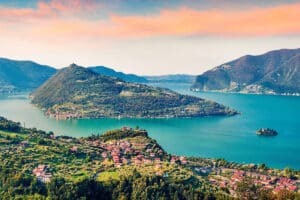
Lake Iseo itself is fundamental. Italy’s fourth largest lake by volume, it acts as a thermal regulator. Helps storing heat in summer, releasing it slowly through autumn and extending the growing season and allowing Chardonnay, Pinot Nero, and Pinot Bianco to ripen slowly and evenly. Without the lake, Franciacorta as we know it does not exist.
The method: why the ageing requirements matter
Franciacorta is produced exclusively by the metodo classico. It is the same technique used in Champagne, in which the wine undergoes secondary fermentation inside the individual bottle. The spent yeast cells remain in contact with the wine for months or years, slowly breaking down through autolysis and contributing the characteristic bready, toasty, creamy qualities that distinguish great sparkling wine from simpler alternatives.
The DOCG ageing requirements are among the most demanding of any sparkling wine appellation in the world. Nonvintage Franciacorta must spend a minimum of 18 months on the lees which is six months longer than Champagne’s legal minimum. Vintage Franciacorta requires 30 months; Riserva a minimum of 60 months. Can you imagine five full years? These are not arbitrary numbers. Longer lees contact means more autolytic complexity, more depth, more of what makes great sparkling wine great.
That Franciacorta’s regulations set higher standards than Champagne’s equivalent categories is a deliberate statement about this appellation’s ambitions.

The grapes and the styles
The permitted varieties can be said the same trio used in Champagne, with Pinot Bianco substituting for Meunier. Chardonnay provides structural backbone and citrus freshness; Pinot Nero adds red fruit character and depth; Pinot Bianco contributes floral delicacy. Most Franciacortas blend two or all three, but the individual styles are worth knowing
The history: Italy’s first sparkling DOCG
Franciacorta’s identity as a sparkling wine region began in 1961 when Guido Berlucchi and enologist Franco Ziliani produced the first metodo classico Franciacorta. DOC status followed in 1967. The decisive moment came in 1995, when Franciacorta became the first Italian sparkling wine to receive DOCG status and it was awarded specifically for the metodo classico wines, with the still wines given a separate DOC entirely. It was a commitment to quality over volume, and a signal that this appellation intended to be taken seriously at the highest level.
Lake Iseo and Montisola: the landscape around the wine
The Franciacorta zone sits within one of the least touristy and most genuinely beautiful lake landscapes in northern Italy. Lake Iseo is quieter and less discovered than Garda or Como. Also it contains Monte Isola, the largest inhabited lake island in central and western Europe, rising 600 metres from the water and home to 1,700 people who live without private cars among steep olive groves and fishing villages. A boat cruise to Monte Isola, followed by a Franciacorta cellar tasting in the afternoon, produces exactly the kind of day that is simultaneously restorative and genuinely instructive. It is the combination that the best wine travel always delivers.
Veditalia’s VIP Lake Iseo and Franciacorta experience runs as a private full day tour with a hotel pickup, lake cruise, cultural time on Montisola, and a curated tasting at a prestigious Franciacorta estate.
For groups of up to seven, it is one of the most complete introductions to a wine region that most international visitors have never discovered.
👉 Book the VIP Lake Iseo, Montisola & Franciacorta experience from Milan →